Easy returns on eligible ordersExperience worry-free shopping with our 60-Day Easy Returns & Exchanges policy.
Size Tolerance Notice:All dimensions are manually measured and may vary slightly. A deviation of 1–2cm is within the normal range.
Color DisclaimerProduct photos are taken from real items. Due to lighting and screen differences, actual colors may vary slightly. Please refer to the actual product.
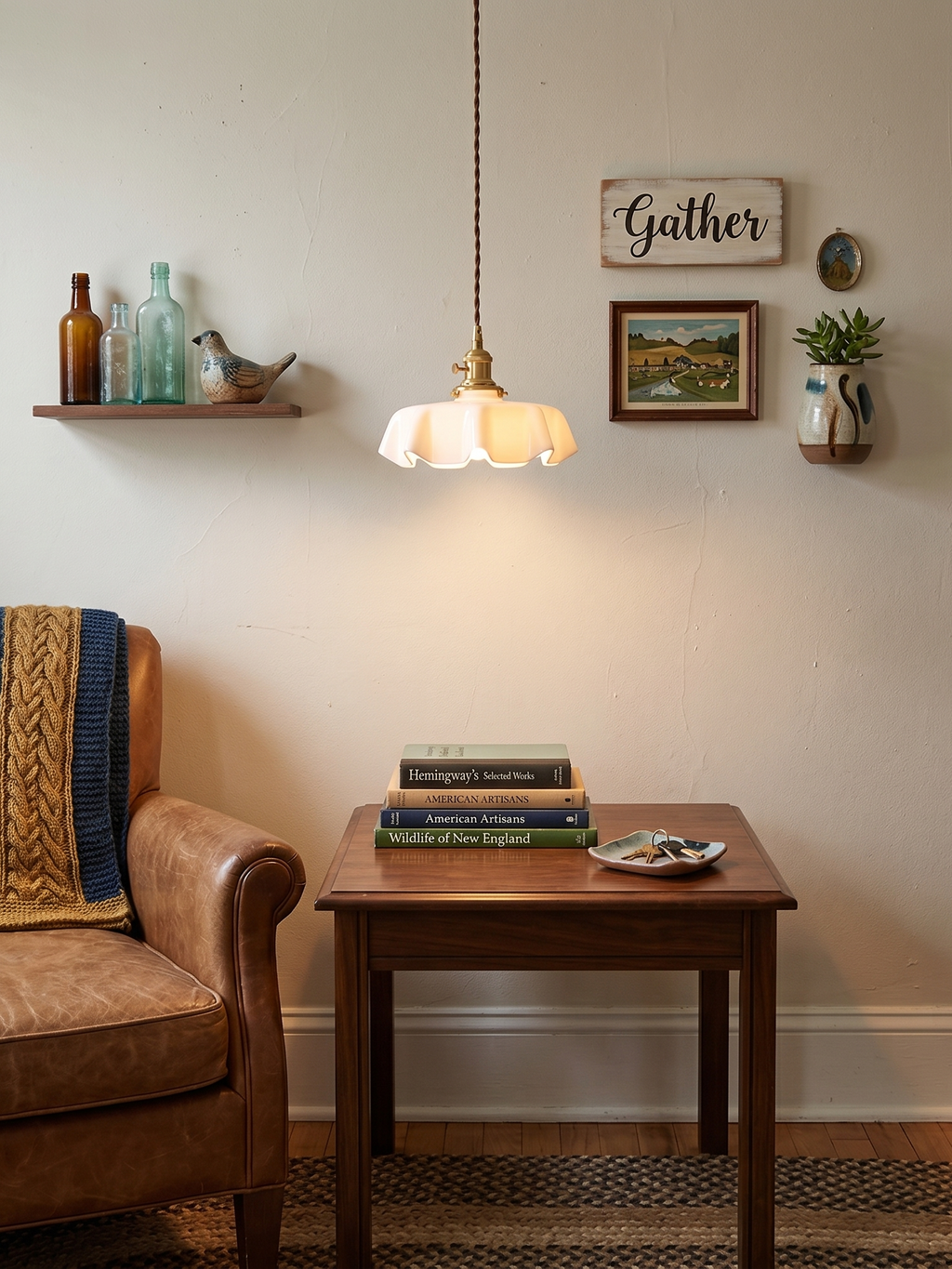
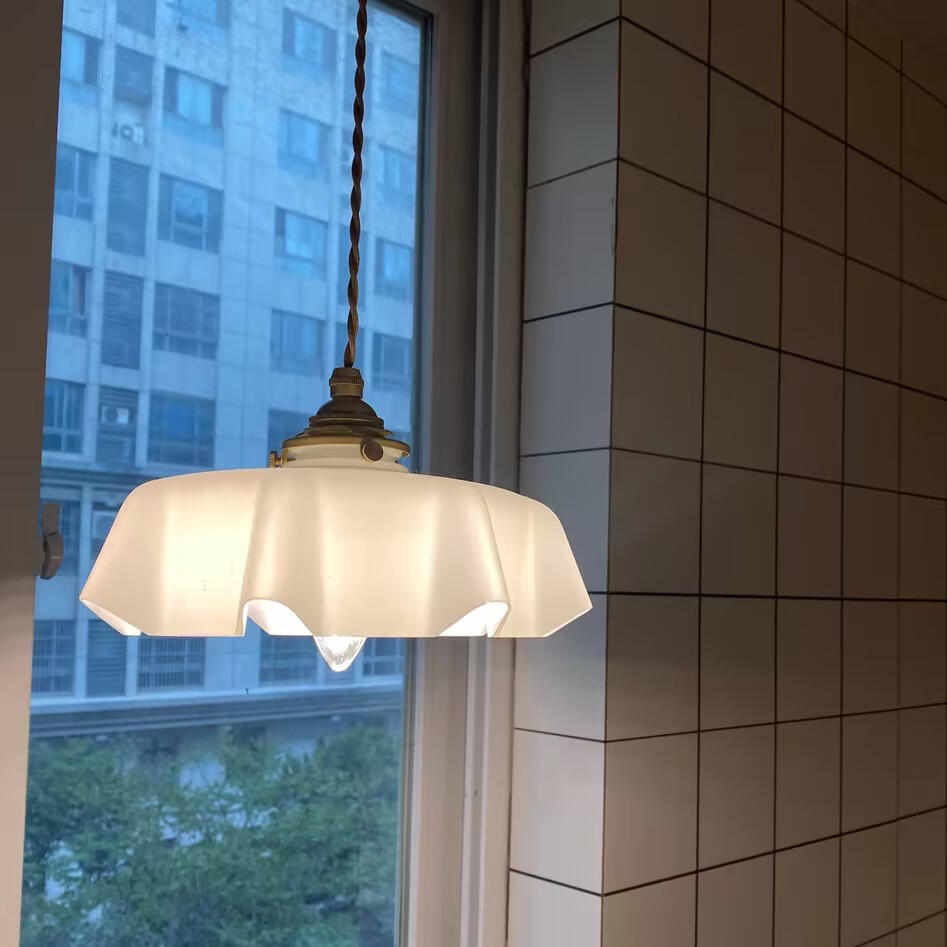
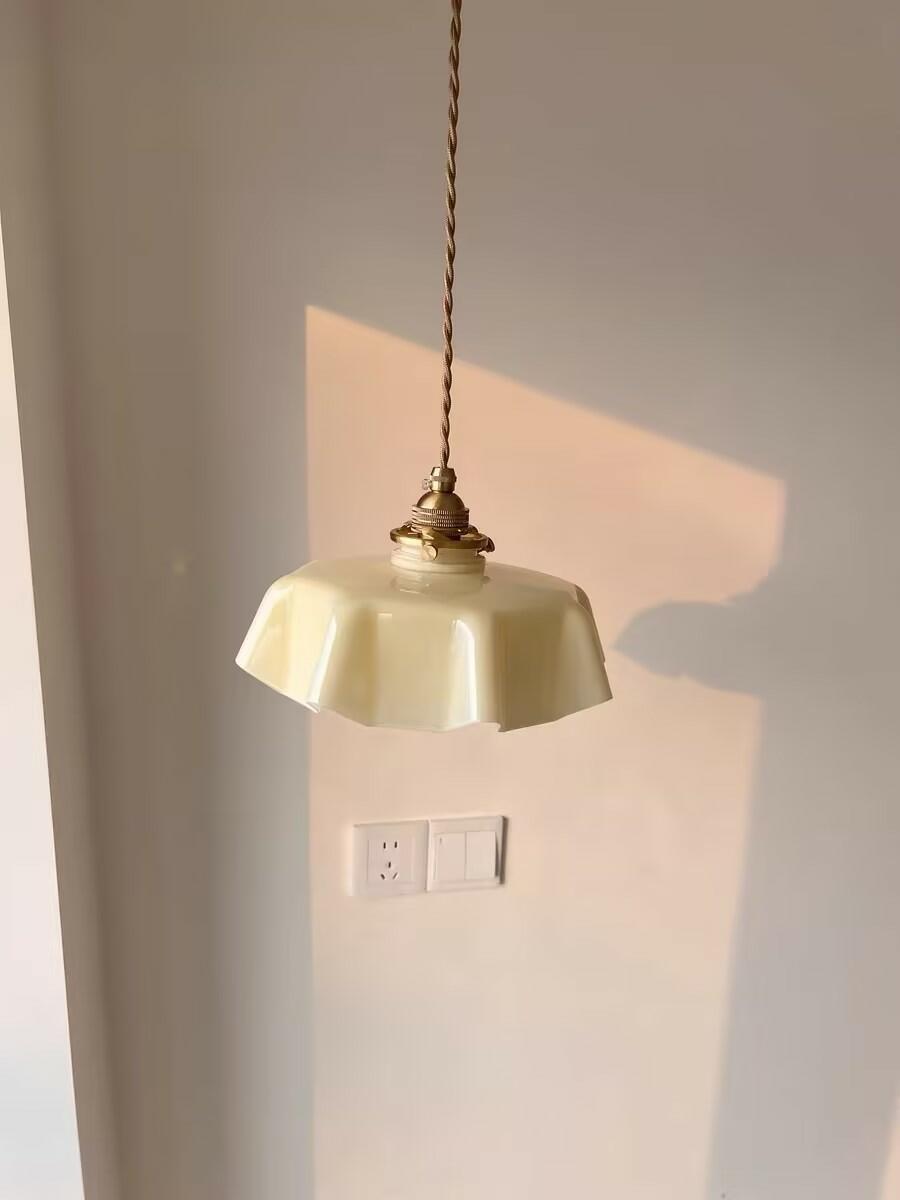
Designed and developed by Vakkerlight — taking inspiration from the past to produce new lights with a vintage feel. The French Flower Pendant Light brings French vintage charm to any interior with its pleated glass shade and warm brass body.
"French vintage pendant lamp in lampshade pleated effect — vintage French charm in a delicate bloom."
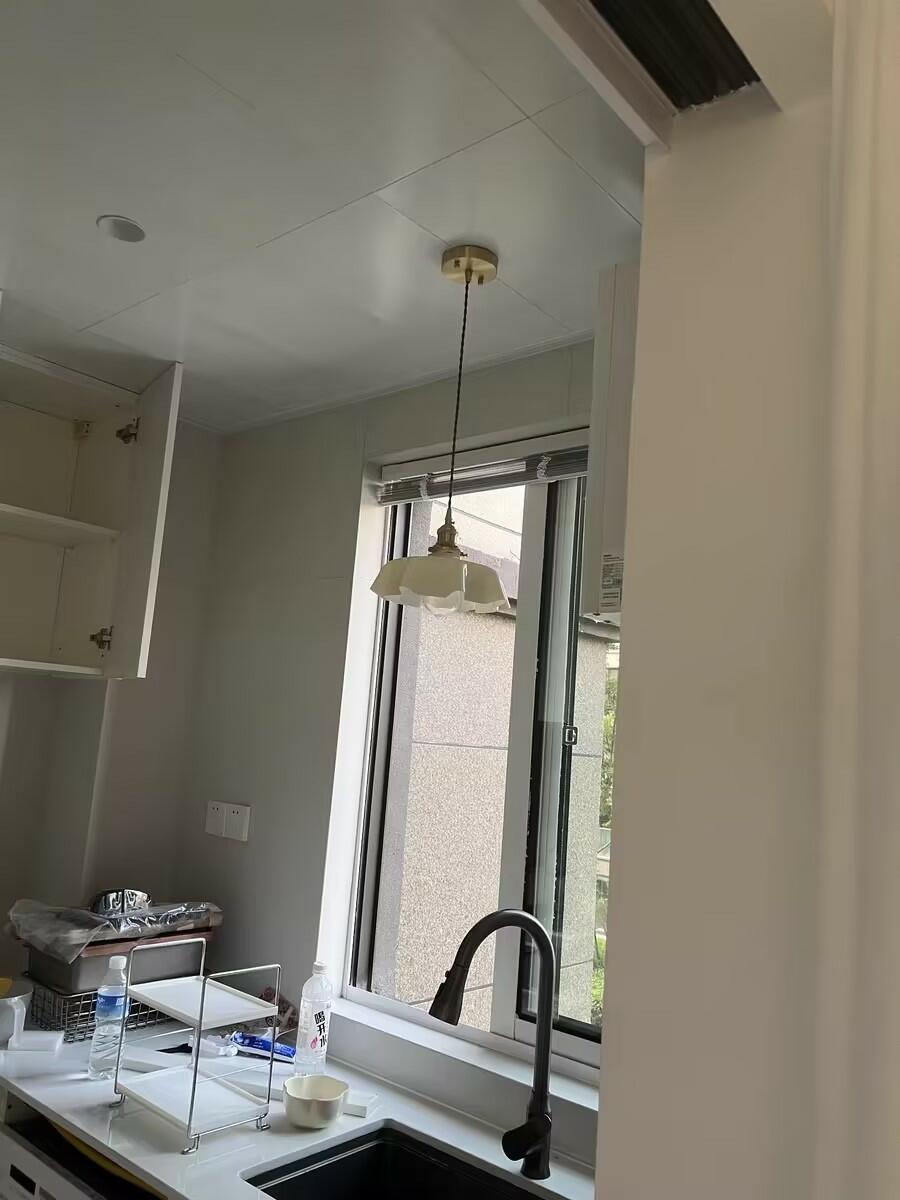
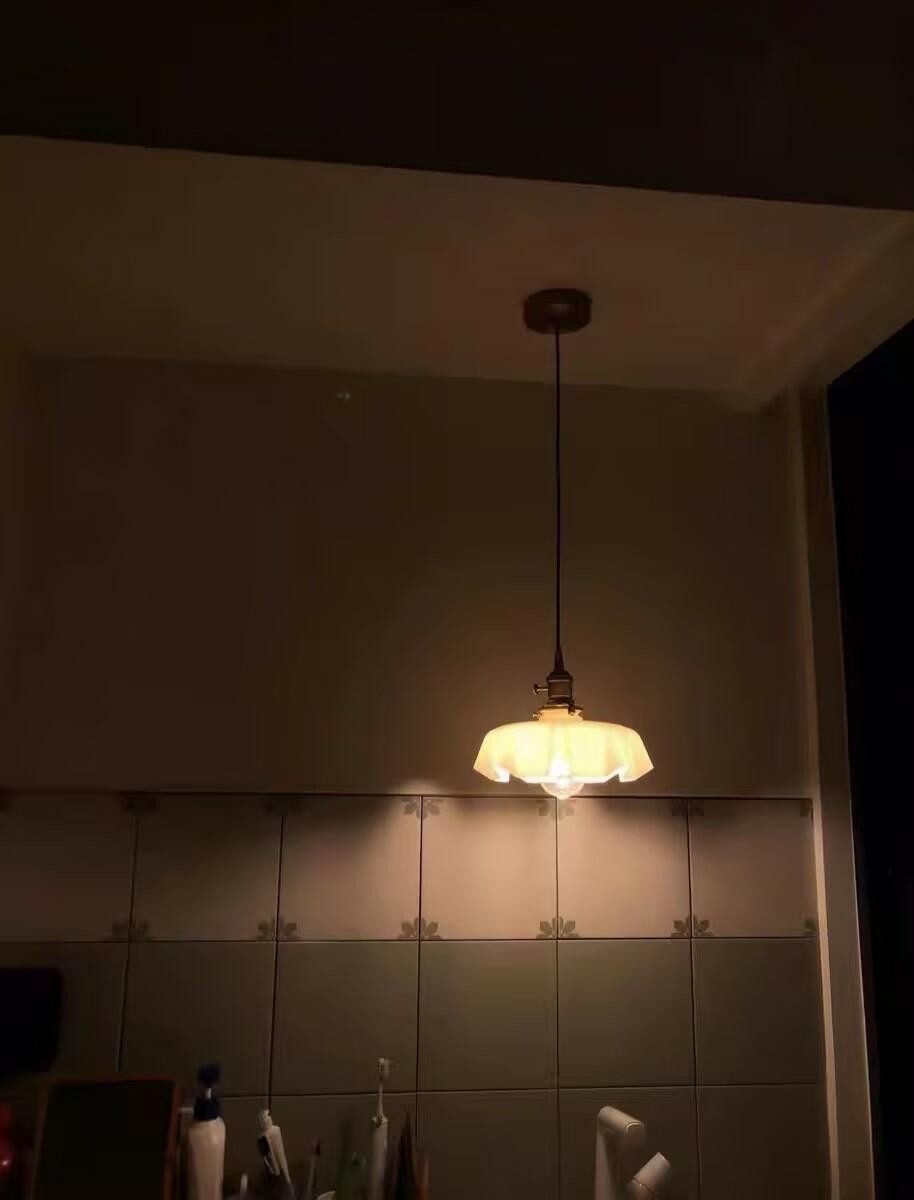
See It In Action
Vintage French charm in a delicate bloom
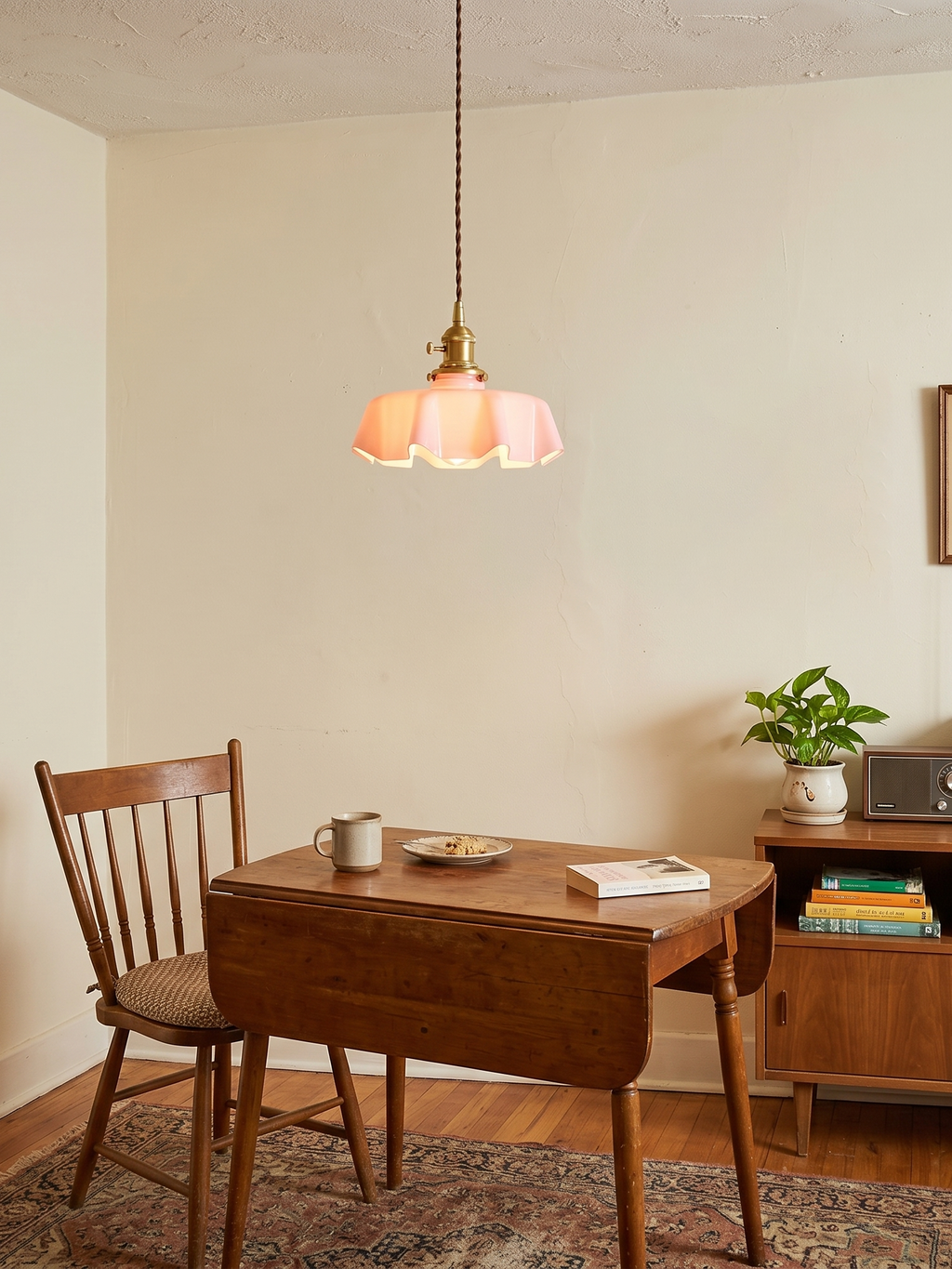
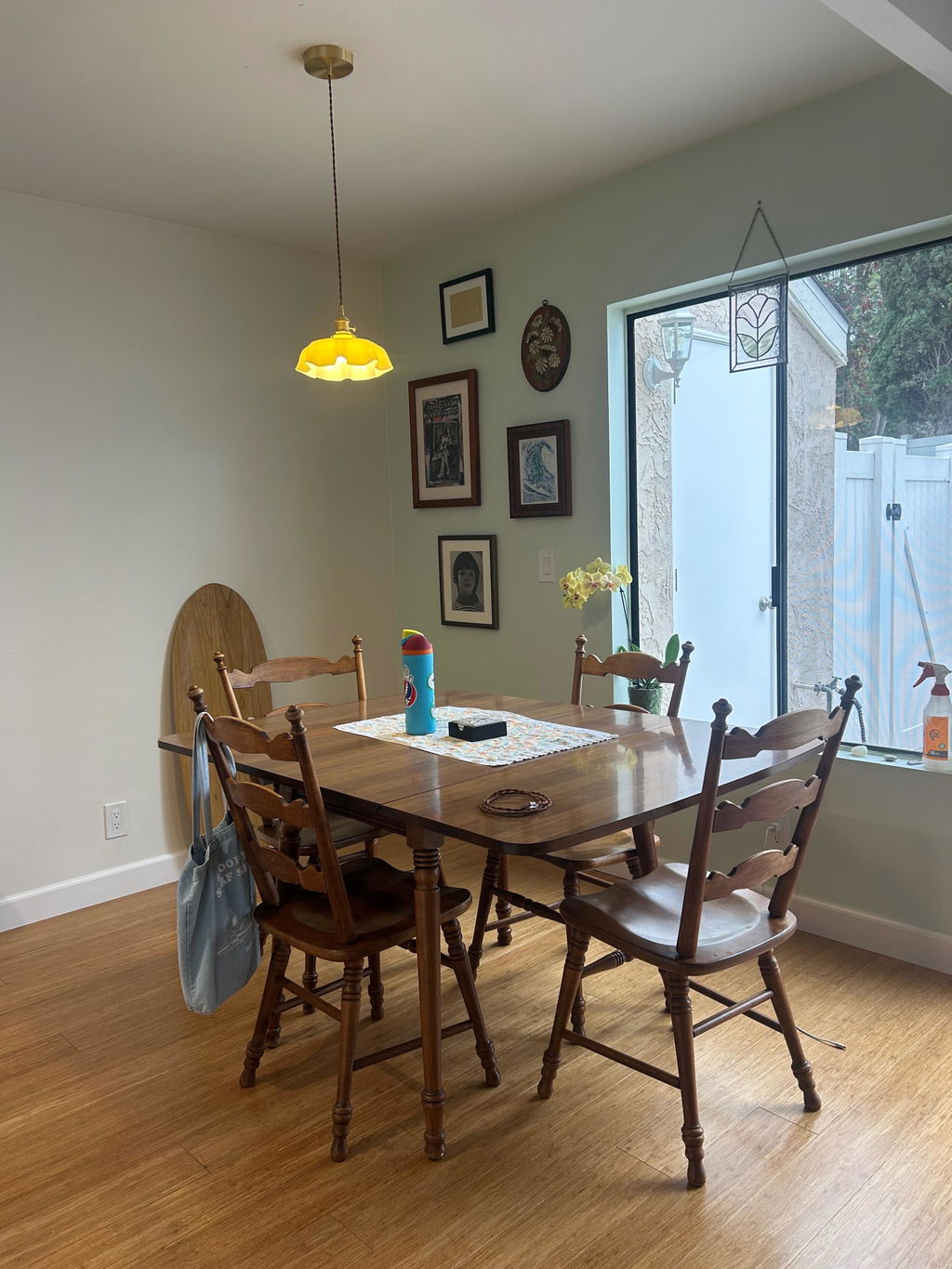
Styled interior
Color variants
Brown cable — standard, no alternative available
This fixture comes with a brown cable. If the cable color is a concern for your installation, please consider this before purchasing. No alternative cord color is available.
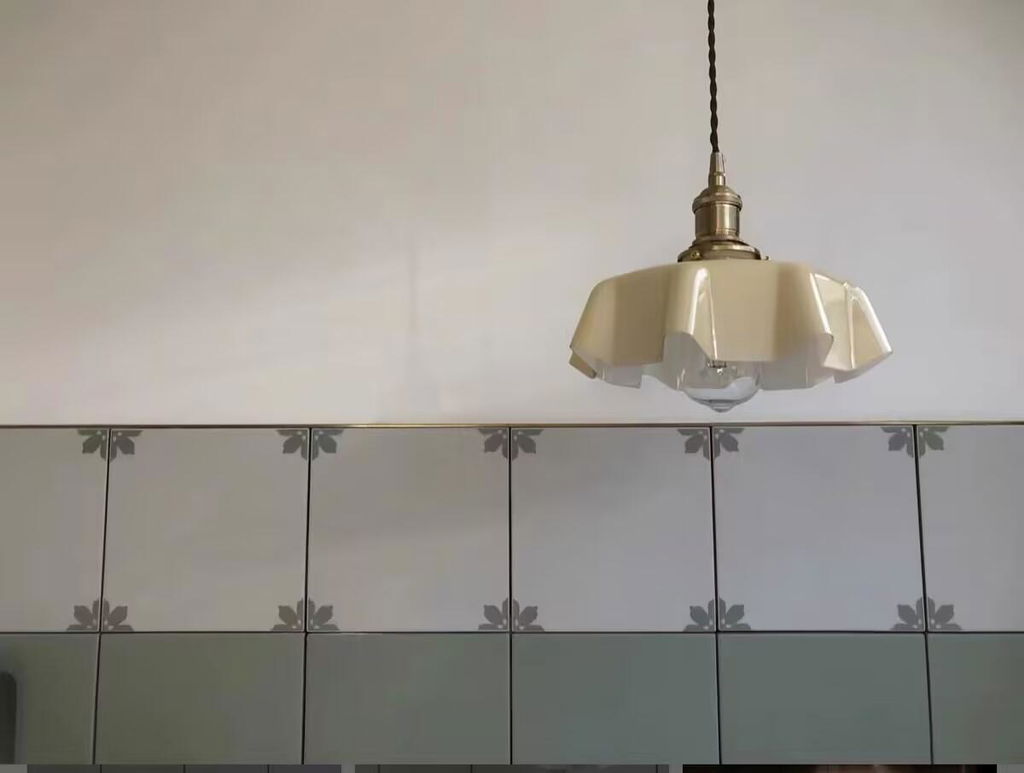
Warm brass frame with a vintage French character — timeless across modern and classic interiors.
4 Shade Colors
White, Beige, Pink, or Blue — choose the tone that complements your palette.
Dimensions
∅9.8"
Diameter (25 cm)
H5.1"
Height (13 cm)
Cable: 59" (150 cm) adjustable · Brown · Extendable on request
Size reference
Shade Colors
White
Beige
Pink
Blue
Body: Brass · All shade colors · Pleated glass
Bulb & Light Source
E26 or E27 base — bulb not included
Uses a standard E26 or E27 base. A warm Edison filament bulb (2700K) is recommended — it completes the vintage French aesthetic beautifully through the pleated glass shade. Bulb not included.
Specifications
Materials
Brass · Glass (pleated)
Light source
E26 / E27 base · LED or Edison (not included)
Voltage
AC 110–240V
Cable
59" (150 cm) adjustable · Brown Extendable on request · No alternative color available
Brown. This is the standard cable — no alternative color is available. Please consider this before purchasing if cable color matters to your installation.
What shade colors are available?
Four pleated glass shade colors: White, Beige, Pink, and Blue. The body is Brass for all.
What bulb does it use?
E26 or E27 base. A warm Edison filament bulb (2700K) is recommended for the vintage French aesthetic. Bulb not included.
Can the cable be extended?
Yes. The standard 59" (150 cm) cable can be extended on request — contact us for high-ceiling installations.
If it is a product quality problem or transportation damage, we will provide free return and exchange services, ensuring a hassle-free experience for our customers.
Where do orders ship from?
Orders are fulfilled from one of the following locations, depending on the item:
United States warehouse for eligible in-stock items
100,000 square feet Asian production base for made-to-order, customized, or supplier-direct items
The shipping origin for a specific product may vary depending on stock availability and product type.
Processing time
Estimated processing times are as follows:
U.S. warehouse items: 1–5 business days
Factory-direct items: 3–10 business days
Customized or made-to-order items may require additional production time.
Estimated delivery time
Estimated transit times are as follows:
U.S. warehouse shipments: typically 3–7 business days after dispatch
Factory-direct shipments: typically 2–5 weeks after dispatch
Please note that delivery times are estimates only and may vary due to carrier delays, customs clearance, weather, holidays, remote delivery locations, or other factors outside our control.
Need an item by a specific date?
If you need an order by a certain date, please contact us before placing the order so we can check availability and shipping options.
While we will do our best to assist, we cannot guarantee delivery by a specific date unless we have confirmed this with you in writing in advance.
Express shipping
Express shipping may be available for certain items and destinations at an additional cost. Please contact us before ordering for a shipping quote.
Shipping costs are shown at checkout based on the destination, item type, weight, and shipping method selected.
We may offer free shipping promotions on qualifying orders or destinations. Any such offer will be shown at checkout or on the relevant product page.
All prices on our website are listed in U.S. Dollars (USD) unless otherwise stated.
Customs duties, import taxes, and VAT
For international orders, customs duties, import taxes, VAT, and related clearance fees may apply depending on the destination country’s laws and import thresholds.
Unless otherwise expressly stated at checkout, these charges are the buyer’s responsibility.
If customs or the carrier requests additional information for clearance, the customer may need to cooperate by providing the required documentation or confirmation.
Address and delivery issues
Please make sure your shipping address and contact details are correct at the time of ordering.
If there is a delivery issue caused by an incomplete address, incorrect address, failed delivery attempt, refusal to cooperate with the carrier, or failure to collect a parcel when required, the customer may be responsible for any resulting additional shipping, storage, return, or redelivery charges.
We will do our best to assist in communicating with the carrier, but in some cases the recipient may need to contact the local carrier directly to arrange redelivery or pickup.
Returned, refused, or undeliverable parcels
If a parcel is returned to us because of:
an incorrect or incomplete address,
repeated failed delivery attempts,
refusal of delivery,
failure to pay applicable customs charges,
or failure to collect the parcel from the carrier,
then any original shipping charges, return shipping charges, customs-related charges, and redelivery fees may be deducted from any eligible refund or charged before reshipment.
If the customer requests a refund for a returned parcel, the refund will be processed only after the parcel has been received back and inspected.
Non-delivery while in transit
Orders cannot be refunded solely because they have not arrived by a preferred date while they are still in active transit.
If a parcel is confirmed lost by the carrier, or if there is another verified shipping issue, we will review the case and provide assistance in accordance with our shipping and refund policies.
Shipping restrictions
We may be unable to ship certain items to some countries, regions, or remote areas due to carrier limitations, customs restrictions, local regulations, product size, or logistics constraints.
If we are unable to ship your order after it is placed, we will contact you to discuss available options.
Return policy
For information about returns, refunds, cancellations, and non-quality-related return shipping responsibility, please refer to our Return & Refund Policy:
Design with Confidence: Vakkerlight 3D Lighting Service
Take the guesswork out of lighting design. Whether for residential or commercial spaces, Vakkerlight’s innovative 3D Lighting Design Service lets you visualize and customize fixtures in a realistic 3D environment before you buy.
Personalized Solutions: Custom arrangements tailored to your exact space.
True-to-Life 3D: See how your fixtures will look before installation.
Expert Support: Get 1-on-1 guidance from our design specialists.
Resources & Support: Visit our [3D Lighting Design Service page] to learn more. Need 3D Max files or detailed product parameters? Email us at info@vakkerlight.com and our team will be happy to assist you.
Welcome to Vakkerlight's 3D Services page! We pride ourselves on offering comprehensive design support to meet all your lighting needs. If you require 3D drawings, CAD plans, or space design services, our experienced support team is here to help.
How to Calculate the Right Size Light Fixture for a Room
When selecting a light fixture, you need to ensure it's appropriately scaled to the room size. The wrong size can affect both aesthetics and functionality. Here are the professional guidelines to help determine the correct light fixture size:
Vakkerlight · Buying Guide
Lighting Size & Installation Guide
Choosing the right fixture is as much about proportion as it is about light. This guide walks you through professional sizing formulas, room-specific rules, ceiling height considerations, and our curated product picks for every space.
Lighting is not only functional — it's a key design element in every room. The wrong size fixture can make a grand room feel claustrophobic, or a small room feel busy. Getting the scale right is one of the most impactful decisions you'll make when designing a space.
This guide gives you the professional formulas used by interior designers, with room-specific rules for chandeliers, pendants, flush mounts, sconces, and more.
Section 01
How to Calculate the Right Size Light Fixture
Three professional formulas cover almost every fixture decision. Apply them in order — diameter first, then fixture height, then hanging height.
1 — Fixture Diameter
The most universally used formula for ceiling fixtures. Works for chandeliers, pendants, flush mounts, and semi-flush mounts.
Measure the length and width of the room in feet.
Add the two numbers together.
Convert the total to inches — this is your ideal fixture diameter.
📐 Example: A room that is 12 ft wide × 14 ft long → 12 + 14 = 26 → a fixture with a 26-inch diameter is ideal.
2 — Fixture Height
Height matters as much as diameter. A fixture that's too short for its room looks stubby; too tall and it overwhelms the space.
Formula
× 2.5–3″
Multiply ceiling height (in feet) by 2.5 to 3 inches. The result is the ideal fixture height.
Example
25–30″
10-foot ceiling → 10 × 2.5–3 = 25–30 inches. That's how tall your chandelier or pendant should be.
3 — Hanging Height Above a Surface
For fixtures hung above dining tables, kitchen islands, or countertops, hanging height determines both function and visual balance.
Over Dining Table
32–36″
Bottom of fixture to table surface. Low enough to illuminate, high enough to see across the table.
Over Kitchen Island
32–36″
From pendant base to countertop. Consistent with dining tables, optimised for task lighting.
4 — Multiple Pendants
When hanging multiple pendants over a long surface, size each fixture relative to the surface below.
◈ Rule: Each pendant should be approximately ¼ the length of the surface below it. Space them evenly from end to end, leaving at least 6 inches clearance at each end.Three pendants spaced evenly over a dining table or island — each pendant ¼ the length of the surface, hung 32–36 inches above the countertop.
Section 02
Ceiling Height Considerations
Ceiling height shapes every fixture decision — from what type of fixture you choose to how long the cord should be. Here are the three key categories.
Low Ceilings ≤ 8 ft
Flush Mount
Choose fixtures that sit close to the ceiling. Flush or semi-flush mounts maximise headroom while providing full ambient coverage. Avoid pendants with long cords.
Standard Ceilings 9–10 ft
Chandeliers & Pendants Ideal
The sweet spot for most fixtures. Chandeliers and pendants thrive here. Bottom of fixture should clear 7 feet from the floor.
High Ceilings 10 ft +
Go Dramatic
High ceilings demand larger fixtures. Use the height to your advantage — oversized chandeliers, long-drop pendants, or clusters of 3+ draw the eye upward beautifully.
📏 Universal Rule: Allow 2.5–3 inches of fixture height for every foot of ceiling height. This keeps the fixture visually balanced regardless of room size.
Ceiling Height
Fixture Type
Minimum Floor Clearance
Notes
8 ft Low
Flush / Semi-flush
7 ft
Use shorter cords; avoid bulky downlights
9–10 ft Standard
Pendant / Chandelier
7 ft
Most fixtures designed for this range
10–12 ft
Larger chandeliers
7.5 ft
Extend cord; choose taller shades
12 ft +
Oversized / Cluster
8 ft
Consider multi-light clusters or grand chandeliers
Vaulted / Sloped
Any (check canopy)
7 ft min
All Vakkerlight pendants include sloped-ceiling canopies
Section 03
Room-by-Room Sizing Guide
Every room has a different lighting logic. Use the tabs below to find sizing rules, fixture recommendations, and installation tips for your space.
Living Room
The living room is often the largest and most complex space to light. It benefits from layered lighting — ambient overhead, task lamps, and accent sconces working together.
📐 Fixture Diameter: Room Length (ft) + Room Width (ft) = Diameter in inches. Ensure at least 7 feet of clearance from the fixture bottom to the floor.
Room Size
Recommended Diameter
Floor Clearance
Under 150 sq ft
14–22″
Min 7 ft
150–250 sq ft
22–28″
Min 7 ft
250–400 sq ft
28–36″
Min 7.5 ft
400+ sq ft / Open plan
36–48″ or cluster
Min 8 ft
💡
Layer your light: Pair a statement chandelier or pendant with floor lamps beside sofas and table lamps on side tables. Ensure floor lamps are proportionate to the furniture they accompany.
Dining Room
The dining chandelier is the room's focal point. It should complement the table size without overwhelming the chairs or the diners.
📐 Key Rule: Fixture diameter should be ½ to ⅔ the width of the dining table. Hang 32–36 inches above the table surface.
Table Size
Single Fixture
Two Fixtures (each)
36″ round / 4-seat
16–22″
10–14″
48–60″ rectangular / 6-seat
22–28″
14–18″
72–84″ rectangular / 8-seat
28–36″ or two
18–24″
96″+ farmhouse table
Use 2–3 pendants
20–28″
✦
Multiple pendants over long tables: For rectangular tables over 72 inches, two or three smaller pendants spaced evenly create a balanced rhythm without one oversized fixture dominating the space.
Kitchen
Kitchen lighting is about task efficiency first, then aesthetics. Islands and peninsulas need strong, focussed pendant lighting — supplement with recessed and under-cabinet lights for full coverage.
📐 Key Rule: Each pendant = ¼ the length of the island. Hang 32–36 inches above the countertop. Space multiple pendants 24–30 inches apart (center to center).
Island Length
Pendants
Each Diameter
Hang Height
Under 48″
1
10–16″
28–34″ above counter
48–72″
2
10–14″ each
28–34″
72–96″
2–3
10–16″ each
28–36″
96″+
3 or 1 linear
12–18″ / 48–72″ linear
30–36″
🪵
Under-cabinet lighting: Install LED strips or puck lights beneath upper cabinets to illuminate the countertop work zone — essential for food prep and appreciated every evening.
Bedroom
Bedrooms need warm, layered light. The central ceiling fixture provides ambient coverage; bedside lamps or sconces handle reading and task lighting.
📐 Key Rule: Use the room dimension formula for the ceiling fixture. For bedside pendants, hang so the shade center sits at eye-level when seated in bed (typically 48–60 inches from the floor).
Use Case
Fixture Diameter
Height / Placement
Central ceiling pendant
Room formula (length + width in inches)
Min 7 ft from floor
Bedside pendant (hanging)
8–14″
48–60″ from floor
Above-bed decorative pendant
16–24″
72–84″ from floor
Bedside table lamp
See Bedside Sizing Table below
Eye-level when seated
Bathroom
Bathroom lighting is about eliminating shadows, especially around the vanity. Side-mounted sconces outperform overhead vanity bars for facial task lighting.
📐 Key Rule: Sconces should be mounted 65–70 inches from the floor, flanking the mirror. Space them 24 inches above the vanity for even, shadow-free light.
Fixture Type
Placement
Notes
Vanity Sconces
65–70″ from floor, either side of mirror
Most flattering for facial lighting
Overhead Vanity Bar
24″ above mirror top
Use for smaller bathrooms without sconce space
Ceiling Flush Mount
Centred, room dimension formula
Ambient layer; combine with vanity lighting
Shower / Wet Zone
IP-rated recessed lights only
Must meet local electrical code requirements
Entryway & Hallway
The entry chandelier sets the tone for the entire home. This is one space where going bold rarely looks wrong — the vertical drop of a dramatic fixture is particularly effective in double-height entries.
📐 Key Rule: Minimum 7 ft clearance from fixture bottom to floor. In two-storey entries, use the full vertical space — a long-drop pendant creates immediate architectural impact.
Ceiling Height
Fixture Diameter
Drop / Cord Length
8–9 ft
12–20″
Short — 18–24″
10–12 ft
18–28″
Medium — 30–42″
Double height 14–20 ft
24–40″
Long — 48–96″+
🏠
Hallways: Space recessed or flush mount lights evenly — every 8–10 feet — for consistent illumination. Wall sconces at intervals add warmth and eliminate the clinical look of recessed-only hallways.
Home Office
Office lighting should eliminate glare on screens while providing enough ambient light to prevent eye strain over long work sessions.
📐 Key Rule: Use the room dimension formula for the ceiling fixture. Place a dedicated desk lamp for task lighting — never rely on the overhead fixture alone for close work.
Fixture Type
Use
Notes
Ceiling flush / semi-flush
Ambient layer
Diffuse shades reduce screen glare
Desk lamp
Task lighting
Position to the left (right-handers) to avoid hand shadows
Recessed / track lighting
Larger offices
Direct away from screens; aim at walls or work surfaces
Floor lamp
Ambient fill / reading corner
Torchiere style bounces light off ceiling for soft fill
Section 04
Bedside Lamp Sizing
A bedside lamp that's too tall throws light in your eyes; too short and the shade hides behind the pillows. These proportions apply to almost any table lamp style.
Lamp Part
Ideal Measurement
Total height
Equal to the height of the nightstand + 2–3 inches
Shade height
½ to ⅔ of the total lamp height
Shade width (widest)
Twice as wide as the lamp base
Base height
⅓ of the total lamp height
Base width (widest)
½ of the shade width
🛏
Seated eye-level rule: When sitting up in bed, the bottom edge of the lampshade should be roughly at your eye level — typically 20–24 inches above the nightstand surface. This prevents both glare and under-lighting.
Section 05
Browse by Fixture Type
Shop our full range of lighting by category — each collection is curated for a specific function, form, and room type.
What size chandelier do I need for a 12 × 14 ft dining room?
Using the room dimension formula: 12 + 14 = 26 inches — so a chandelier with a 26-inch diameter is ideal for the room. For the dining table specifically, the fixture should be 50–70% of the table width. Hang it 32–36 inches above the table surface.
How low should a pendant hang over a kitchen island?
The bottom of the pendant shade should sit 32–36 inches above the countertop. With a standard 36-inch counter height, that puts the shade bottom at 68–72 inches from the floor — high enough to not obstruct sightlines while cooking, low enough to cast effective task light.
Can I use a chandelier in a room with an 8-foot ceiling?
Yes, but carefully. Choose a compact chandelier (under 12 inches tall) with a short canopy and minimal cord. The bottom of the fixture must clear 7 feet from the floor. In dining rooms with 8-foot ceilings, a semi-flush chandelier or low-profile pendant is often more practical and visually balanced.
How many pendants should I hang over a 6-foot kitchen island?
For a 72-inch island, two pendants is ideal (each around 10–14 inches in diameter), centered at 18 and 54 inches from one end. Alternatively, one linear pendant spanning 48–60 inches provides even, elegant coverage without the spacing calculation.
What is the best bulb colour temperature for home lighting?
For living rooms, bedrooms, and dining rooms: 2700K–3000K (warm white). For kitchens and home offices where task accuracy matters: 3000K–3500K (neutral white). Avoid 5000K+ daylight bulbs in residential spaces — they create a cold, clinical atmosphere that works against most home interiors.
Are Vakkerlight fixtures compatible with sloped ceilings?
Yes. All Vakkerlight pendant and chandelier fixtures include a sloped-ceiling compatible swivel canopy that accommodates ceiling angles up to 45 degrees. For steeper slopes, contact our support team at info@vakkerlight.com or call +1 800-715-2593 and we'll advise on the best approach.
Here’s a voltage reference chart for various countries. Feel free to contact us with any questions. Enjoy your shopping!
Vakkerlight · Installation Support
Global Voltage Reference Guide
A practical reference for international voltage standards, frequency differences, and device compatibility — everything you need to safely install your Vakkerlight fixture anywhere in the world.
📖 7 min readUpdated April 202530+ Countries Covered
When purchasing lighting fixtures for use across different countries, understanding the local voltage system is essential. Using a fixture or device with the wrong voltage can damage it instantly, trigger a circuit breaker, or in worst cases create a fire hazard. This guide gives you a clear, no-jargon reference so you can shop and install with confidence.
All Vakkerlight fixtures are rated AC 110–240V, making them compatible with virtually every electrical system worldwide. This guide will help you understand your local system, verify device labels, and identify what accessories — if any — you may need.
Section 01
The Two World Voltage Systems
Almost every country in the world uses one of two voltage standards. Understanding which system you're in is the single most important step before purchasing or installing any electrical fixture.
System One
120V
60 Hz
Countries
United States Canada Mexico Parts of Central & South America Parts of Japan
Plug Type A / B
System Two
230V
50 Hz
Countries
UK · Germany · France · Italy Spain · Australia · India China · South Korea Most of Europe, Africa & Asia
Plug Type C / E / F / G / I
⚡ The core rule: North America (and a few others) runs on 120V / 60Hz. The rest of the world runs on 220–240V / 50Hz. These two systems require different wiring, different transformers, and in most cases different fixtures — unless the device is dual-voltage.
North America — United States & Canada
The US and Canada use a standardised 120V / 60Hz system throughout. Plugs are Type A (two flat parallel prongs, ungrounded) and Type B (two flat prongs plus a round grounding pin). Most household lighting circuits run at 15 or 20 amps.
Voltage
120V
Standard household supply. Some appliances (ranges, dryers) use 240V, but lighting circuits are always 120V.
Frequency
60 Hz
Consistent nationwide. LED drivers and electronic transformers work equally well on 50Hz or 60Hz.
Europe — UK, Germany, France, Italy & Beyond
Most of Europe uses a 220–240V / 50Hz system. However, plug types vary by country — Germany and most of continental Europe use Type F (Schuko), France uses Type E, and the UK uses the distinct three-pin Type G plug with built-in fuse.
⚠️
Moving from the US to Europe? A plug adapter alone is not enough. Without a voltage converter, connecting a US 120V device to a European 230V socket will immediately damage it. Always verify the voltage rating on the device label first. If it reads "100–240V," you only need a plug adapter.
Section 02
Country-by-Country Reference
The expanded table below covers the most common countries for Vakkerlight customers worldwide. Use it to instantly verify your local system before placing an order or installing a fixture.
Voltage compatibility matters before any fixture is installed — verify your supply voltage against your fixture's rated input before connecting power.
Country
Voltage
Frequency
Plug Type(s)
VKL Compatible
North America & Pacific
United States
120V
60Hz
Type A, B
✓ Yes
Canada
120V
60Hz
Type A, B
✓ Yes
Mexico
127V
60Hz
Type A, B
✓ Yes
Japan
100V
50/60Hz
Type A, B
Contact Us
Australia
230V
50Hz
Type I
✓ Yes
New Zealand
230V
50Hz
Type I
✓ Yes
Europe
United Kingdom
230V
50Hz
Type G
✓ Yes
Ireland
230V
50Hz
Type G
✓ Yes
Germany
230V
50Hz
Type C, F
✓ Yes
France
230V
50Hz
Type C, E
✓ Yes
Italy
230V
50Hz
Type C, F, L
✓ Yes
Spain
230V
50Hz
Type C, F
✓ Yes
Netherlands
230V
50Hz
Type C, F
✓ Yes
Sweden / Norway / Denmark
230V
50Hz
Type C, F
✓ Yes
Switzerland
230V
50Hz
Type C, J
✓ Yes
Portugal
230V
50Hz
Type C, F
✓ Yes
Asia & Middle East
China
220V
50Hz
Type A, C, I
✓ Yes
South Korea
220V
60Hz
Type C, F
✓ Yes
India
230V
50Hz
Type C, D, M
✓ Yes
UAE / Saudi Arabia
220–240V
50Hz
Type G (UAE), Type A/B/G (KSA)
✓ Yes
Singapore
230V
50Hz
Type G
✓ Yes
Hong Kong
220V
50Hz
Type G
✓ Yes
🇯🇵
Japan note: Japan runs on 100V, which falls just below the lower end of our 110–240V range. Most Vakkerlight LED fixtures will function, but we recommend confirming with our team before installation. Contact us at info@vakkerlight.com.
Section 03
How to Read Your Device Label
Every electrical device has a label — usually on the back, underside, or power supply brick — that tells you exactly what voltage and frequency it accepts. Learning to read this label takes 30 seconds and can prevent permanent damage to your fixture.
Label Example — Dual-Voltage (Safe Worldwide)
Input100–240V ~ 50/60Hz
Output12V DC 2A
Wattage24W Max
Status✓ Safe in any country — plug adapter only needed
Label Example — North America Only (Caution)
Input120V ~ 60Hz only
Output—
Wattage60W Max
Status⚠ Requires step-up transformer outside North America
Label Example — Europe Only (Caution for US buyers)
Input220–240V ~ 50Hz only
Output—
Status✗ Will not work in North America without step-down transformer
🔍 The one thing to look for: If the input label reads "100–240V", the device is dual-voltage and works worldwide. If it reads a single voltage range (e.g. "120V only"), it requires a converter outside its home region.
Section 04
Dual-Voltage Devices & When You Need a Converter
Modern electronics — including most LED drivers, smartphone chargers, and laptop power bricks — are designed to accept a wide voltage range. These dual-voltage devices make international travel and relocation far more convenient.
Dual-Voltage Device
100–240V
Works in any country. Only requires a plug adapter to match the local socket shape. No transformer needed.
North America Only
120V Only
Requires a step-up transformer when used in 220–240V countries. Size the transformer to at least 2× the device wattage.
European / World Standard
230V Only
Requires a step-down transformer when used in North America (120V). Cannot be used in Japan (100V) without conversion.
Do I still need a plug adapter?
Yes — even with a dual-voltage device, you will still need a physical plug adapter if the socket shape in your country is different from the device's plug. For example, a US device with a Type A plug will not fit into a UK Type G socket without an adapter.
💡
Sizing your voltage converter correctly: Always choose a transformer rated at least 2× the wattage of the device you intend to run. For example, a 60W lighting fixture should use a minimum 120W transformer. Running a converter at maximum capacity continuously shortens its lifespan and may cause overheating.
Section 05
Vakkerlight Fixture Compatibility
Every Vakkerlight lighting fixture is rated for AC 110–240V, 50/60Hz — the full dual-voltage range. This means our fixtures work directly out of the box in any country, on any standard electrical system, without a voltage converter.
Input Voltage
110–240V
Covers all household electrical systems worldwide. Compatible with US 120V, European 230V, Australian 230V, and all systems between.
Frequency
50/60Hz
Compatible with both North American (60Hz) and global (50Hz) grid frequencies. No frequency converter needed anywhere.
Bulb Base by Region
When you order from Vakkerlight, we automatically match the correct bulb base to your shipping destination. No action is required from you — but if you need to request a specific base for a custom installation, contact us before placing your order.
Shipping Region
Bulb Base Assigned
Voltage
Converter Needed?
United States Auto
E12 (Candelabra)
120V
No
Canada Auto
E12 (Candelabra)
120V
No
United Kingdom
G9 Bi-pin
230V
No
Germany / France / Italy
G9 Bi-pin
230V
No
Australia / New Zealand
G9 Bi-pin
230V
No
UAE / Saudi Arabia
G9 Bi-pin
220–240V
No
Japan
E12 (confirm first)
100V
Recommended — contact us
📩
Questions about your specific order? Our team can confirm voltage compatibility and bulb base for any fixture before you buy.
Email: info@vakkerlight.com ·
Phone: +1 800-715-2593
Address: 1520 Caton Center Dr. Suite L-M, Baltimore MD 21227
Section 06
Related Guides & Collections
Explore our other installation references and browse the collections most relevant to your project.
Are all Vakkerlight fixtures compatible with both 120V and 230V?
Yes. Every Vakkerlight fixture is rated AC 110–240V, 50/60Hz — the full international dual-voltage range. This means our fixtures work directly out of the box in the US, Canada, Europe, Australia, and most countries worldwide, without any voltage converter.
What is the difference between 50Hz and 60Hz, and does it matter for lighting?
50Hz and 60Hz refer to the number of times per second the electrical current alternates direction. For modern LED fixtures and electronic drivers, the difference has no practical effect — they are designed to handle both. Older dimmer switches and some motor-driven devices may behave slightly differently between frequencies, but this is not a concern for standard Vakkerlight fixtures.
I'm ordering from the US but shipping to the UK — what should I do?
The fixture itself is voltage-compatible (110–240V). The difference is the bulb base — US orders are shipped with E12 bases, while UK orders receive G9 bases. If you are shipping to the UK, please use a UK delivery address at checkout so the correct base is assigned. If you've already ordered, contact our team at info@vakkerlight.com and we can advise.
Can I use a Vakkerlight fixture in Japan (100V)?
Japan uses 100V, which falls just below our rated input range of 110–240V. Most LED drivers handle minor under-voltage without issue, but we recommend confirming your specific fixture with our team before installation. Contact us at info@vakkerlight.com or call +1 800-715-2593.
What happens if I connect a 120V fixture to a 230V supply?
The device will likely fail immediately — components are exposed to twice their rated voltage and will overheat or burn out. In the worst case this can cause a fire. Always check the voltage rating on the device label before connecting. This is why all Vakkerlight fixtures are rated 110–240V — to eliminate this risk entirely.
Do I need a separate voltage converter if my device is dual-voltage?
No — if your device's label reads "100–240V, 50/60Hz," it accepts all standard voltage systems worldwide. You only need a physical plug adapter to match the local socket shape. No transformer or voltage converter is required. Vakkerlight fixtures fall into this category and work globally without any additional equipment.
Vakkerlight · Installation Support
Global Plug & Socket Guide
A complete reference for plug types, voltage standards, and adapter requirements across every major region — so your Vakkerlight fixture arrives ready to install, wherever you are in the world.
📖 6 min readUpdated April 202515 Plug Types Covered
North AmericaEuropeUK & IrelandAustraliaAsiaIndiaSouth America
Electrical systems vary significantly from country to country — not just in plug shape, but in voltage, frequency, and grounding method. Using a device with the wrong voltage can permanently damage it or create a safety hazard. This guide gives you everything you need to verify compatibility before installing or using a Vakkerlight fixture anywhere in the world.
Common international plug types — Types A through O cover every region worldwide.
Section 01
Plug Types by Region
There are currently 15 standard plug types in global use, designated Type A through Type O. The eight types below cover the vast majority of developed markets where Vakkerlight ships — including all US, EU, UK, and Australian orders.
A
USA · Canada · Mexico · Japan
Two flat parallel pins, ungrounded. The most common plug in North America. No earth pin.
100–127V · 60Hz
B
USA · Canada · Mexico
Two flat pins + round grounding pin. Required for grounded appliances. Used alongside Type A.
100–127V · 60Hz
C
Europe · South America · Asia
Two round pins, ungrounded. Known as the Europlug. Widely compatible across continental Europe.
220–240V · 50Hz
D
India · South Africa
Three large round pins in a triangular arrangement, grounded. Standard across the Indian subcontinent.
220–240V · 50Hz
E
France · Belgium · Poland · Slovakia
Two round pins + socket pin for earthing. Primarily used in France. Compatible with Type F plugs.
220–240V · 50Hz
F
Germany · Spain · Russia · Most of Europe
Two round pins with side grounding clips. The Schuko plug. Works across most of mainland Europe.
220–240V · 50Hz
G
UK · Ireland · Malta · Malaysia · Hong Kong
Three large rectangular pins in a triangular layout, with safety shutters on the socket. Grounded.
220–250V · 50Hz
I
Australia · New Zealand · China · Argentina
Two or three flat angled pins. Australia/NZ use a slanted V-shape; China uses a similar but subtly different standard.
220–240V · 50Hz
Quick Reference Table
Type
Key Countries
Voltage
Frequency
Grounded
A
USA, Canada, Mexico, Japan
100–127V
60Hz
No
B
USA, Canada, Mexico
100–127V
60Hz
Yes
C
Most of Europe, S. America, Asia
220–240V
50Hz
No
D
India, South Africa
220–240V
50Hz
Yes
E
France, Belgium, Poland
220–240V
50Hz
Yes
F
Germany, Spain, Russia
220–240V
50Hz
Yes
G UK
UK, Ireland, Malta, Malaysia
220–250V
50Hz
Yes
I
Australia, New Zealand, China
220–240V
50Hz
Yes (3-pin)
Section 02
Voltage & Frequency Standards
Voltage is the single most important compatibility factor. Using a 220–240V device on a 120V circuit will cause it to run too dimly or not at all. The reverse — using a 120V device on a 220–240V circuit — can permanently damage or destroy the device, and is a fire risk.
120V
60 Hz
United States Canada Mexico parts of Japan
Type A / B
100V
50 / 60 Hz
Japan (varies by region)
Type A / B
230V
50 Hz
UK · Germany France · Spain Most of Europe
Type C / E / F / G
230V
50 Hz
Australia New Zealand China
Type I
⚡ Key distinction: North America runs on 120V / 60Hz. Almost everywhere else in the world runs on 220–240V / 50Hz. These systems are fundamentally incompatible without a voltage converter.
Frequency — Does it matter?
Usually Not
Most modern LED drivers and electronic transformers work fine on both 50Hz and 60Hz. The exception is some older clocks, motors, and dimmable fittings that are frequency-sensitive.
Voltage — Does it matter?
Always
Voltage mismatch is the primary cause of device failure and electrical fires. Always verify your fixture's rated voltage matches the local supply before connecting.
Travel adapters modify plug shape only — they do not convert voltage. Always verify your device's voltage rating separately.
Section 03
Adapting Between Countries
There are two separate problems to solve when using a device internationally: changing the plug shape, and changing the voltage. These require different solutions and are often confused.
Plug Adapter
Shape Only
A plug adapter changes the physical shape of the plug to fit a different socket type. It does not convert voltage or frequency. Safe to use only when voltage is already compatible.
Voltage Converter
Voltage + Shape
A step-up or step-down transformer converts the electricity from one voltage to another. Required when moving a non-dual-voltage device between the US/Japan and the rest of the world.
⚠️
Common mistake: Buying a plug adapter when you actually need a voltage converter. A plug adapter alone will let you physically connect a 120V device to a 230V socket — but the device will receive double its rated voltage and will likely fail or catch fire. Always check the device label first.
✅ How to check: Look for a label on your device or power supply that reads "100–240V, 50/60Hz" — this means it is dual-voltage and only needs a plug adapter. If it reads only "120V" or only "230V", you need a voltage converter.
Section 04
Common Travel Scenarios
Use the reference below to find exactly what you need for the most common international combinations — plug adapter, voltage converter, or both.
US / CA→Europe
Type A/B → Type C/E/F. Voltage difference (120V → 230V) requires a step-up converter unless your device is dual-voltage. Always check first.
US / CA→UK
Type A/B → Type G. Both a plug adapter and a voltage converter are needed unless the device is rated 100–240V.
Europe→UK
Type C/E/F → Type G. Same voltage (230V), so only a plug adapter is needed — no voltage converter required.
Australia→US / CA
Type I → Type A/B. Voltage difference (230V → 120V) requires a step-down converter unless device is dual-voltage.
Europe→Australia
Type C/E/F → Type I. Same voltage range (230V), so only a plug adapter is needed. Compatible voltages make this a simple conversion.
US / CA→Japan
Type A/B → Type A/B. Same plug type. However, Japan uses 100V — not 120V — so many US devices (rated 120V) may run slightly dim or underperform.
Section 05
Dual-Voltage Devices
Many modern devices — including smartphones, laptops, and LED driver power supplies — are designed to accept both voltage standards. These are significantly more convenient for international use as they only require a plug adapter, not a voltage converter.
🔍 How to identify: Look for the label on the device or its power supply. A rating of "100–240V, 50/60Hz" confirms dual-voltage compatibility. A rating of "120V only" or "230V only" means the device requires a voltage converter when used internationally.
Dual-Voltage
100–240V
Plug adapter only. No voltage converter needed. Works worldwide with the appropriate plug shape.
North America Only
120V
Step-up transformer required for use in Europe, Australia, or UK. Check device wattage to size the converter.
Europe / World
230V
Step-down transformer required for use in North America. Cannot be used in Japan (100V) without conversion.
🌐
Universal travel adapter recommendation: If you travel frequently between regions, invest in a universal travel adapter with built-in surge protection. For voltage conversion needs, use a branded transformer rated to at least 2× the wattage of the device you intend to power — running a converter at its maximum rating shortens its lifespan.
Section 06
Vakkerlight Fixture Compatibility
All Vakkerlight lighting fixtures are rated for AC 110–240V input, making them fully compatible with both North American and international electrical systems. The correct bulb base is automatically selected based on your shipping address.
US & Canada Orders
E12 Base
Candelabra base, standard for North American chandelier and pendant fixtures. Compatible with E12 LED or Edison-style bulbs.
EU & Australia Orders
G9 Base
Bi-pin base standard for European and Australian markets. Compatible with G9 LED capsule bulbs.
Region
Voltage
Plug Type
Bulb Base Shipped
Adapter Needed
United States Auto
120V · 60Hz
Type A / B
E12
None
Canada Auto
120V · 60Hz
Type A / B
E12
None
United Kingdom
230V · 50Hz
Type G
G9
Type G canopy
Germany / France
230V · 50Hz
Type C / E / F
G9
Type C/F canopy
Australia
230V · 50Hz
Type I
G9
Type I canopy
Japan
100V · 50/60Hz
Type A / B
E12
Step-up transformer
📦
Bulb base is matched automatically: When you order from Vakkerlight, our team assigns the correct bulb base for your region based on your shipping address. You do not need to specify — but if you need a different base for a custom installation, contact us at info@vakkerlight.com before placing your order.
Section 07
Frequently Asked Questions
Do I need a voltage converter to use a Vakkerlight fixture in Europe?
No. All Vakkerlight fixtures are rated AC 110–240V and are compatible with both North American (120V) and European (230V) electrical systems. You will need an appropriate plug adapter or canopy for your socket type, but no voltage converter is required.
What is the difference between a plug adapter and a voltage converter?
A plug adapter changes only the physical shape of the plug to fit a different socket type. It does not change the voltage or frequency. A voltage converter (or transformer) actually converts the electricity from one voltage level to another — essential when moving devices between 120V and 230V systems.
What bulb base will my Vakkerlight fixture arrive with?
US and Canada orders receive E12 (candelabra) base sockets. EU and Australia orders receive G9 bi-pin sockets. The base is automatically matched to your shipping address — you don't need to specify anything during checkout. If you require a different base, please contact us before ordering.
Can I use a Type A plug in a Type C socket?
Not directly — the physical pin shapes are incompatible. You would need a Type A to Type C plug adapter. However, you must also verify that your device is rated for 220–240V before connecting it to a European socket. Using a 120V-only device in a 230V socket (even via an adapter) will cause damage.
Does frequency (50Hz vs 60Hz) affect lighting fixtures?
For most modern LED fixtures and electronic drivers, no — they are designed to work on both 50Hz and 60Hz. Older incandescent or certain dimmable fixtures may show minor performance differences between frequencies, but this is rarely noticeable in practice. All Vakkerlight fixtures with integrated LED drivers support both frequencies.
I'm shipping to Japan — do I need any special setup?
Japan uses 100V, which is lower than our standard 110–240V range. While many devices tolerate 100V at the lower end of their range, we recommend confirming with our support team before installing in Japan. Contact us at info@vakkerlight.com or call +1 800-715-2593 and we'll advise on your specific fixture.
At Vakkerlight, glass is treated as a medium of light itself. Each glass lamp is crafted using carefully selected glass materials, shaped through refined techniques that balance clarity, thickness, and form. Subtle variations and delicate textures give every piece its own character, celebrating the beauty of handcrafted glass.
Our glass lighting is created through a precise and controlled process:
Glass Forming & Shaping — Molten glass is blown or molded to achieve balanced proportions and smooth contours Controlled Cooling & Annealing — Gradual cooling enhances strength, clarity, and durability Hand Finishing & Detailing — Edges and surfaces are refined by hand for a clean, elegant finish Assembly & Light Testing — Each lamp is assembled and tested to ensure optimal light diffusion and safety
Light Refined by Transparency
Glass softens and transforms light, creating a gentle glow that enhances atmosphere without glare. Whether clear, frosted, textured, or tinted, Vakkerlight glass lamps deliver warm, diffused illumination that elevates both modern and classic interiors.
It's so cute! It adds the perfect touch to the corner of my living room.
I
Isaac Blake
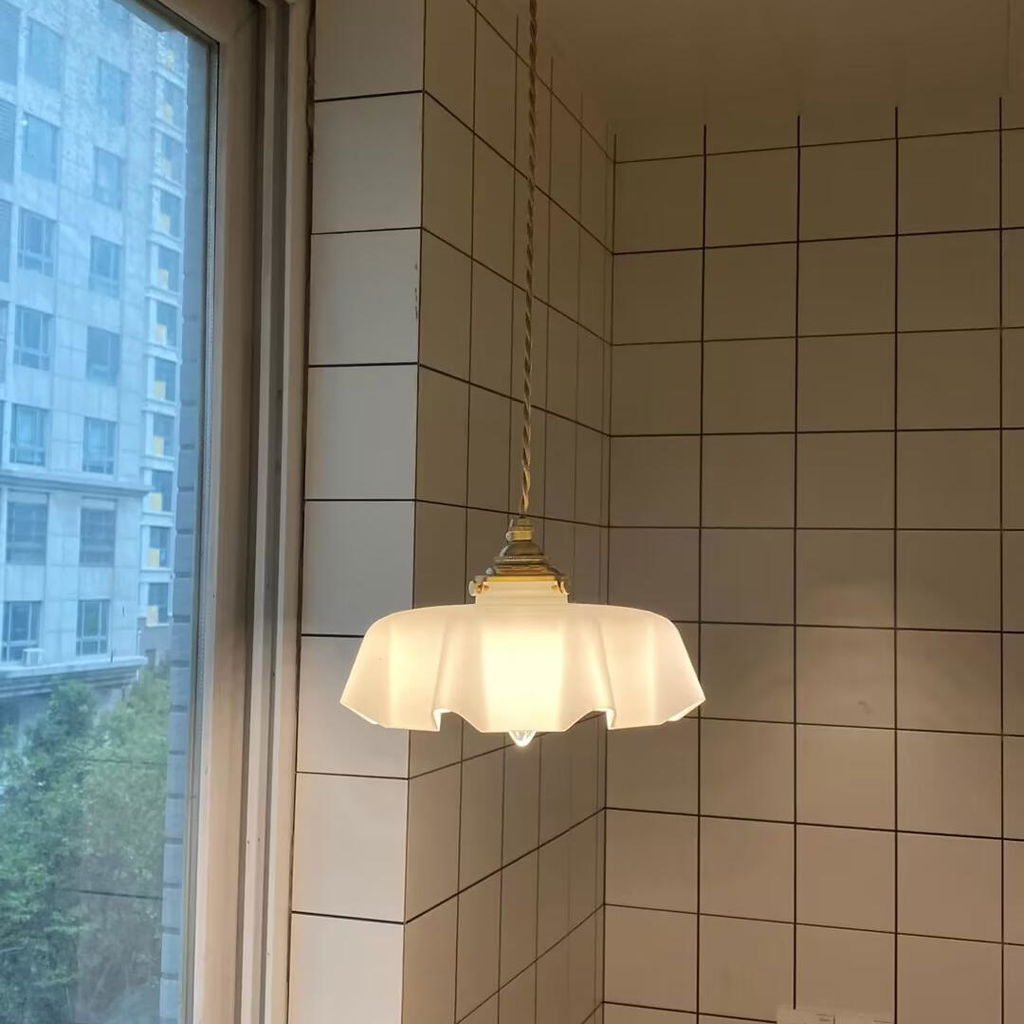
I absolutely love this pendant light! It's beautiful, very elegant, and well-made. It was well-packaged, and all the parts were intact. No damage whatsoever! The instructions were simple and easy to understand, and it was very easy to assemble. Highly recommended.
N
Natalie Evans
I love this flower pendant light. It makes our dining room bright and beautiful. The item arrived well-packaged and undamaged. Highly recommend.
C
Cory
Exactly As Pictured
This cute little light is great for our small dining area. Easy to install. Packaged very securely. Doesn’t give off a ton of light but perfect for our space. Now I want it in other colors, too!
W
William Ford
This pendant light is absolutely stunning! It was beautifully and carefully packaged. I would definitely buy from them again.
Explore our most sought-after product collections, where innovative design meets exceptional craftsmanship. Perfectly tailored to enhance every corner of your home with style and functionality.
Alabaster Lamp Collections
Elegant alabaster lighting with a soft, refined glow.